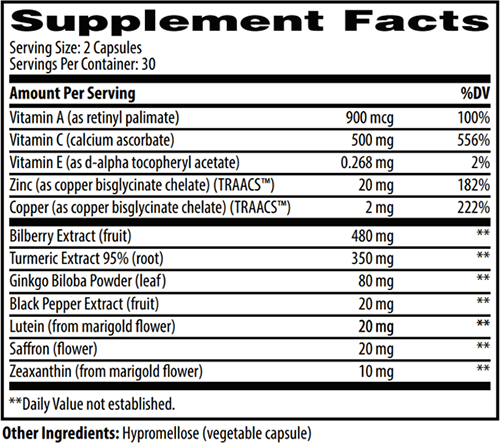
Complete current ingredient list
Vitamin A
900 mcg per 2-capsule serving
Vitamin C
500 mg per 2-capsule serving
Vitamin E
0.268 mg per 2-capsule serving
Zinc
20 mg per 2-capsule serving
Copper
2 mg per 2-capsule serving
Bilberry Extract (fruit)
480 mg per 2-capsule serving
Turmeric Extract 95% (root)
350 mg per 2-capsule serving
Ginkgo Biloba Powder (leaf)
80 mg per 2-capsule serving
Black Pepper Extract (fruit)
20 mg per 2-capsule serving
Lutein (from marigold flower)
20 mg per 2-capsule serving
Saffron (flower)
20 mg per 2-capsule serving
Zeaxanthin (from marigold flower)
10 mg per 2-capsule serving
The label also lists hypromellose as the vegetable capsule.
Why label hierarchy matters
One older-looking promotional image supplied with the asset set shows a different vitamin E amount. Because the direct black-and-white Supplement Facts image and the bottle-back facts panel agree on vitamin E at 0.268 mg, this website uses 0.268 mg rather than mixing the two versions. If the manufacturer later changes the label, the current physical product label should replace older marketing graphics as the source of truth.
Carotenoids: lutein and zeaxanthin
Lutein and zeaxanthin are carotenoids found in the macula. The National Eye Institute included both in the AREDS2 formula, but at 10 mg lutein and 2 mg zeaxanthin — not the 20 mg and 10 mg shown on the current iGenics label. That difference is important when interpreting research.
Vitamins and minerals
NIH describes vitamin A as critical for normal vision because it is part of rhodopsin, a light-sensitive retinal protein. Vitamin C and vitamin E have antioxidant functions. Zinc and copper are essential minerals with many roles in human physiology. Those general nutrient roles do not by themselves prove a branded formula treats an eye disease.
Botanical ingredients
The formula also includes bilberry, turmeric, ginkgo, black pepper and saffron. Evidence varies by ingredient and outcome. For example, NCCIH says evidence for ginkgo is not conclusive for health conditions and warns about possible medication interactions. NCCIH also notes that piperine from black pepper can increase curcumin bioavailability, while highly bioavailable curcumin products may carry additional safety concerns.
References & source notes
- National Eye Institute — AREDS/AREDS2 FAQs
- NIH Office of Dietary Supplements — Vitamin A
- NIH Office of Dietary Supplements — Vitamin C
- NIH Office of Dietary Supplements — Vitamin E
- NIH Office of Dietary Supplements — Zinc
- NIH Office of Dietary Supplements — Copper
- NCCIH — Ginkgo: Usefulness and Safety
- NCCIH — Turmeric: Usefulness and Safety
- PubMed — Saffron therapy for mild/moderate AMD
Independent ingredient research does not establish that the finished iGenics product has been clinically proven. Product-specific facts on this site are taken from the current vendor-provided label and offer materials supplied for this build.